?
|
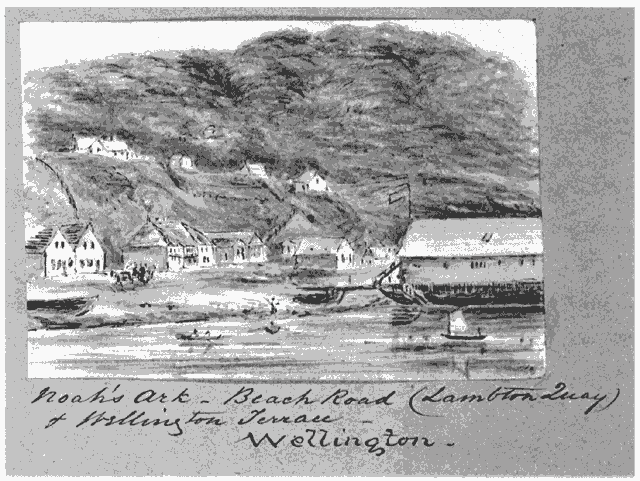
? The 'berth' of a new building Willis St and Lambton Quay were set out in the first plan of Wellington town, and the corner of the two streets was known as Clay Point (it is now often called Stewart Dawson's corner, after a long-established business sited there). Businesses were established along the waterfront in the early 1840's. John Plimmer moved the Inconstant to a spot on the shoreline at Clay point opposite his house in 1850.
The Inconstant remained on this site until 1883, when the building structure was removed and the ship frames cut down to ground level for the construction of the National Mutual Life Association head office that is still standing on the corner of Hunter street and Customhouse Quay. This building was later taken over by the Bank of New Zealand. The earthquake John Plimmer described the massive 1855 earthquake as a "horrid and perilous" situation, and was intrigued by the way the Te Aro bog was moving, "rolling like a heavy sea". Although terrifying at the time, the 1855 earthquake helped the town by pushing the foreshore up, and adding new flat land for development. |
? |
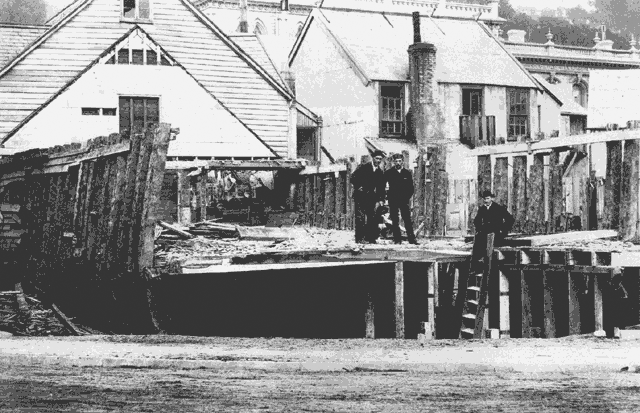
? The earthquake also benefited cricket in Wellington. The Basin Reserve was originally planned as a deepwater harbour with a connecting canal to the sea, based on a stream running between Kent and Cambridge Terraces. The uplift moved the shoreline and drained the stream, but gave Wellington a much-loved recreation ground. Since 1855 there has been further harbour reclamation, giving us the shoreline we see today. Re-birth of 'the Ark' The remaining ship hull was buried beneath the buildings that were constructed on the site. In 1899 it reappeared briefly during the construction of the Bank of New Zealand head office which has been recently refurbished and now trades as the Old Bank Arcade & Chambers. In July 1997 during preparation work for the modification of the historic Bank of New Zealand building, the remains of the Inconstant's hull were uncovered. Wellington City Council retained ownership, and initiated the conservation and display of the remains to portray the remnants of one of Wellington's earliest European commercial enterprises. Four of the five major sections were removed for display and conservation to the Gallery on Queens Wharf. On 29 June 1999 the remaining bow section under the Old Bank was opened for public view.
? |